
Real-Time Ultrasound
Seeing how your body moves helps you learn how to move it better.
Many pelvic floor problems aren’t simply caused by weak muscles. They often involve muscles that activate at the wrong time, fail to relax, or don’t work well with the abdominal wall, diaphragm and deep stabilising muscles.
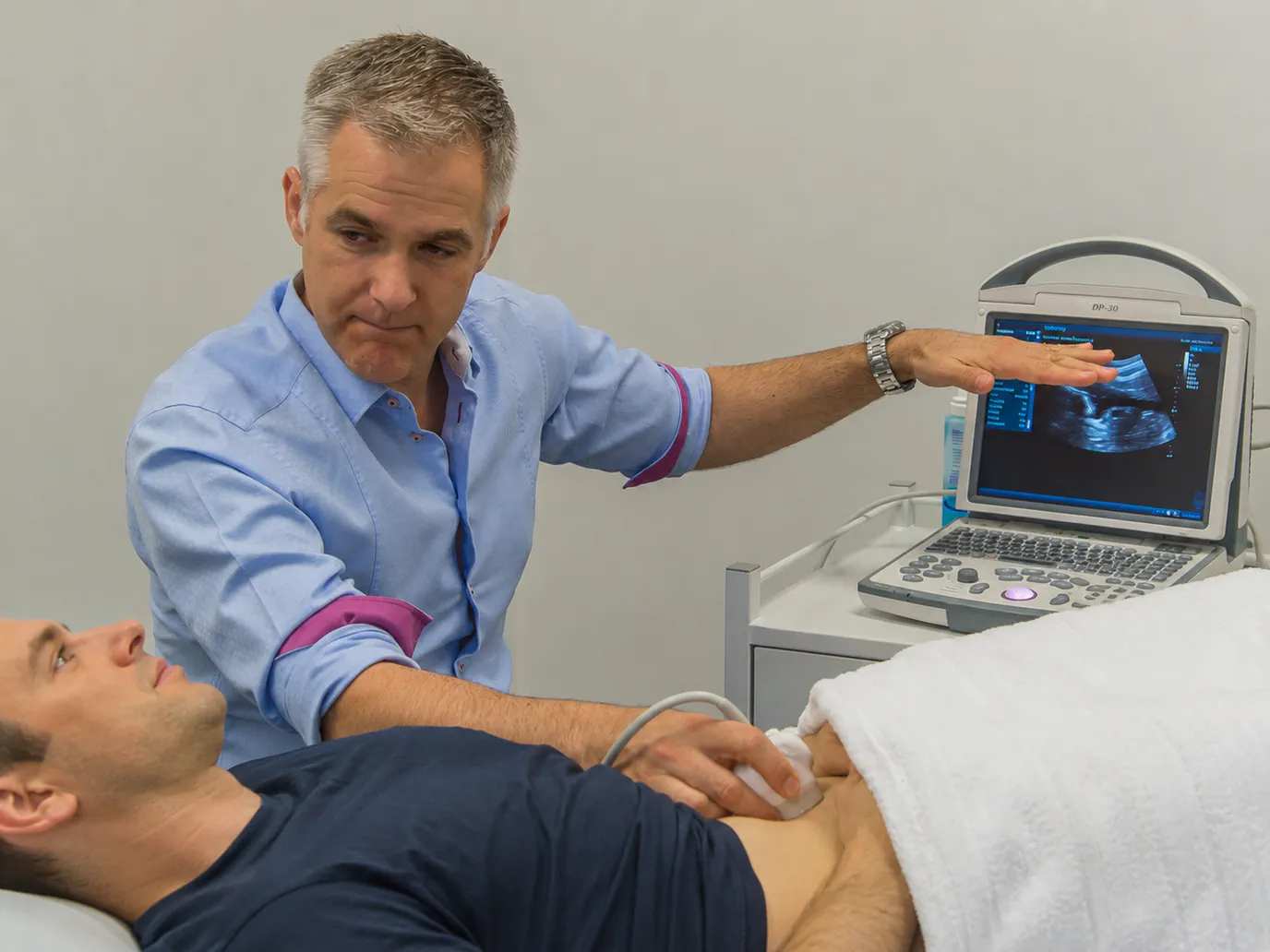
Real-Time Ultrasound lets you and your physiotherapist see these muscles working as they move, providing immediate visual feedback without needles, radiation or internal assessment in many situations.
Rather than relying on guesswork, real-time ultrasound helps guide assessment, improve exercise technique and support more effective rehabilitation.

Each treatment plays a different role. Highlighted below are the systems this one focuses on.
Understanding how your muscles work is often the first step to improving them.
Real-Time Ultrasound lets both you and your physiotherapist observe muscle activity while you breathe, move, contract and relax.
For many people this makes rehabilitation much easier to understand because you can immediately see whether the muscles are working as intended. It also reveals movement patterns that can’t be judged by observation alone.
Our goal isn’t simply to prescribe exercises. It’s to help you understand exactly how your body is moving.
What it helps optimise
Who may benefit
Not everyone will benefit, which is why assessment always comes first.
A small ultrasound probe is gently placed on the skin over your lower abdomen using a water-based gel.
As you perform breathing, pelvic floor and movement tasks, the ultrasound displays your muscles moving in real time, and your physiotherapist explains what you’re seeing.
Because you can immediately see how your muscles respond, many people learn correct movement patterns and gain confidence more quickly. Real-time ultrasound is painless and non-invasive.
Our treatments don’t compete with each other. They complement each other.
This treatment is rarely the entire solution. Depending on your assessment, your personalised programme may also include:
Every recommendation begins with understanding.
You don’t need to know whether this is the right treatment for you. You simply need to know you’d like something to change. Together we’ll identify what’s holding you back and build a personalised pathway forward.
Request a Private Consultation